Coulomb's Law
Understanding the mathematical relationship between electric charges and the forces between them.
What is Coulomb's Law?
Coulomb's law is a quantitative statement about the force between two point charges. When the linear size of charged bodies are much smaller than the distance separating them, the size may be ignored and the charged bodies are treated as point charges.
Coulomb measured the force between two point charges and found that it varied inversely as the square of the distance between the charges and was directly proportional to the product of the magnitude of the two charges and acted along the line joining the two charges.
Thus, if two point charges q₁, q₂ are separated by a distance r in vacuum, the magnitude of the force (F) between them is given by:
Where k is the Coulomb constant, approximately 9 × 10⁹ N·m²/C².
How Coulomb Discovered the Law
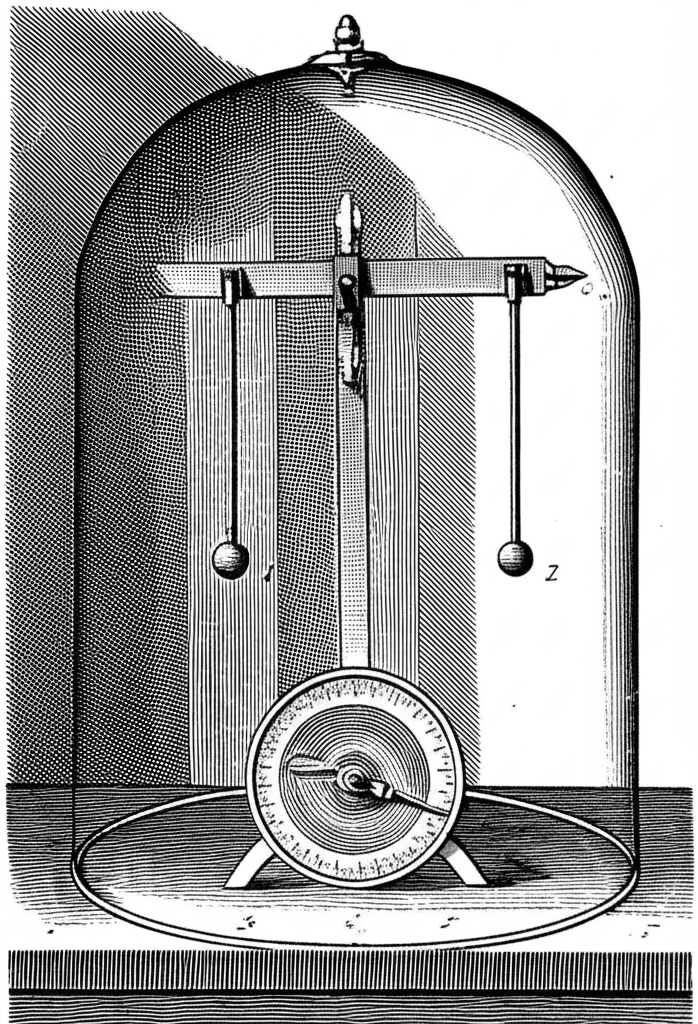
Coulomb used a torsion balance for measuring the force between two charged metallic spheres. When the separation between two spheres is much larger than the radius of each sphere, the charged spheres may be regarded as point charges.
To discover the relationship, Coulomb used a simple method: He would place a charge on a metallic sphere, then touch it with an identical uncharged sphere, causing the charge to spread equally between them (q/2 each).
By repeating this process and measuring forces at different distances, Coulomb was able to establish the inverse square relationship and the proportionality to the product of charges.
The Coulomb Constant and Units
In the formula F = k·|q₁·q₂|/r², the constant k is known as the Coulomb constant. In SI units, the value of k is approximately 9 × 10⁹ N·m²/C².
The Coulomb constant is often written as k = 1/(4πε₀), where ε₀ is the permittivity of free space, with a value of approximately 8.854 × 10⁻¹² C²·N⁻¹·m⁻².
The unit of charge that results from this choice is called a coulomb (C). One coulomb is the charge that, when placed at a distance of 1 meter from another charge of the same magnitude in vacuum, experiences an electrical force of repulsion of magnitude 9 × 10⁹ N.
Key Points:
- The force is directly proportional to the product of the charges
- The force is inversely proportional to the square of the distance
- Like charges repel; unlike charges attract
- The force acts along the line joining the two charges
- The Coulomb constant k = 9 × 10⁹ N·m²/C²
Vector Form of Coulomb's Law
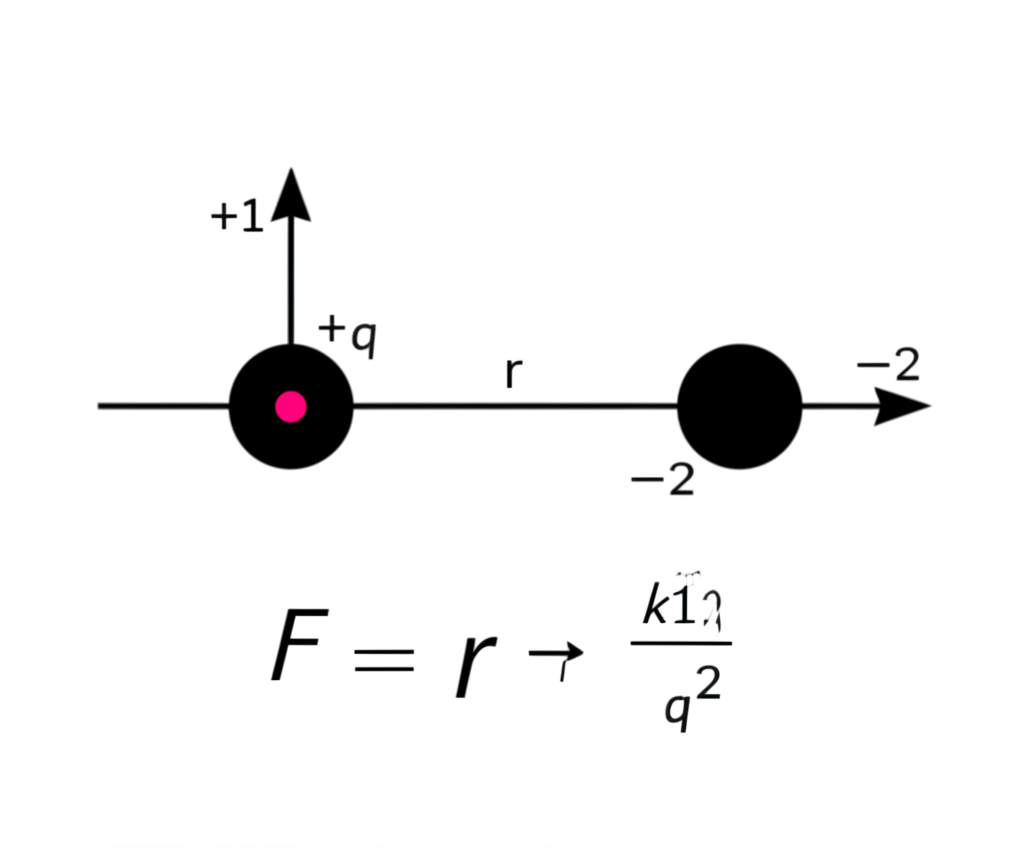
Since force is a vector, Coulomb's law is better expressed in vector notation. If we denote the position vectors of charges q₁ and q₂ as r₁ and r₂ respectively, and the force on q₁ due to q₂ as F₁₂, then:
Where r̂₁₂ is the unit vector pointing from q₁ to q₂, and r is the distance between the charges.
This vector form accounts for both the magnitude and direction of the force:
- If q₁ and q₂ have the same sign, F₁₂ points away from q₂ (repulsion)
- If q₁ and q₂ have opposite signs, F₁₂ points toward q₂ (attraction)
Comparison with Gravitational Force
Coulomb's law for electrostatic force between two point charges and Newton's law for gravitational force between two stationary point masses both have inverse-square dependence on the distance.
However, the electrical force is enormously stronger than the gravitational force. For example:
Comparison:
- The ratio of electric to gravitational force between an electron and a proton is approximately 2.4 × 10³⁹
- The ratio of electric to gravitational force between two protons is approximately 1.3 × 10³⁶
This enormous difference in strength explains why electromagnetic forces dominate in atomic and molecular structures, while gravitational forces only become significant for very large masses.